
Precision Through Thermal and Geometric Compensation

By Dapatech Systems

Dapatech Systems
Dapatech Systems Thermal Aerocompensation Imaging Image

Smart Engineering for Complex Manufacturing

Introducing iTec and GTEC Systems.

At the core of our iTEC and GTEC systems lies an advanced capability to correct both geometric and thermal machine errors — a critical step for industries requiring high-precision manufacturing.

Benefits of iTEC & GTEC Systems

  • Integrated Thermal Compensation
    Our systems adjust for real-time thermal fluctuations, not just static temperature points. This ensures stability even with changing ambient, machine, or part temperatures.

  • Geometric (Volumetric) Accuracy
    Using the same volumetric algorithms as our GTEC system, we correct for angular and structural errors across the machine’s full working volume — especially important for large-format machines where minor misalignments have major impact.

  • Position Dependent
    The error component for each axis is calculated based on the current real-time axis positions, measured error data, and the geometric and thermal models. For every one-micron resolution movement, a correction value is applied ≤ 0.001 mm.

Why Compensation Must Be Integrated, Not Isolated
 
Compensating for head errors (tilts and rotations) separately from X, Y, and Z axis corrections often leads to worse results. At Dapatech, we apply head compensation in sync with full 3-axis error correction to maintain true tool point accuracy.
 
Our GTEC system recalculates and reapplies all compensation values throughout the machine’s movements, ensuring accuracy across the entire toolpath. This method is critical for 5-axis machines where geometric imperfections interact dynamically.
 
Situation: Independent head error correction = higher risk of compounded tool point errors.
 
Outcome: Dapatech’s integrated system = optimal tool accuracy across full volume.

Various versions of the DAPATECH compensation systems have been successfully implemented with many industrial leaders including BAE systems, GKN Aerospace, Micro Metalsmiths and Rolls Royce.

Special Purpose Machinery Design & Integration

DAPATECH delivers advanced special purpose machinery design for complex, high-performance manufacturing environments. Whether you’re producing precision components at scale or developing a custom process, we work alongside your engineering team to design, build, and integrate machinery tailored to your exact requirements.

Our solutions go beyond equipment – we ensure full system integration, including automation interfaces and control systems, to optimise workflow and production throughput. Each system is supported by high-accuracy calibration and alignment services, ensuring every part produced meets strict tolerance standards and quality benchmarks.

Answers for Engineers & Procurement Teams

Common Questions

Developed in partnership with University of Huddersfield (UK), the GTEC system compensates for all thermal & geometric (volumetric) error sources that affect positioning accuracy throughout the entire volume of the machine. Full 5 axis integrated compensation applied from one algorithm (all 31 errors). Any further errors are either a duplication or cannot be compensated such as spindle run out.

Utilises bi-directional data to correct for varying reversal positioning errors.

Interpolates between target positions to apply a new compensation every time a micron of error is predicted – giving better accuracy and smother seamless contour machining.

Flexible thermal compensation system allows reduction of all systematic thermal effects applied infinitely in real time.

The iTEC system compensates for all thermal error sources that affect positioning accuracy throughout the entire volume of the machine. Full 5 axis integrated compensation applied from one algorithm.


Any machine tool that can manufacture products more accurately can therefore create higher efficiency and better reliability in the final assemblies!

Example 1
Green energy – More accurate gearboxes and gears for wind turbine generators enable more power to be produced with less noise pollution and longer economic life without expensive breakdowns.

Example 2
Automotive efficiency – More accurate body panels on cars can provide smaller gaps which will reduce drag hence less fuel consumption! The accurate manufacture of gearboxes also benefit from our systems.

Example 3
Aerospace – More accurate tooling allows for highly precise carbon fibre skins to be fitted without manual adjustment creating cheaper and more efficient aircraft!

Other industries and benefits include production of satellites, communications, military stealth etc.

Less direct energy use in more efficient production by avoiding re-manufacture due to parts produced out of specification.

Energy saving due to less stringently controlled air conditioned environments required for machining.

Firstly the machine needs to be calibrated to the highest possible standard throughout the entire working volume to allow you to fully utilize your machines to produce work to the best possible accuracy.

Why? If the machine accuracy is calibrated to be better than the work piece required accuracy, then part can be machined within tolerance.

Machine tool accuracy > component tolerance = the machine tool is capable of producing the part.

This is achieved by applying compensation on all geometric (volumetric) errors (GTEC) within the machine, (21 errors on 3 axis, 31 errors on 5 axis machines such as 5 axis gantry style with fork head or tilt rotary table).

Secondly the machine needs to be compensated for thermal errors (GTEC & iTEC) acting on the machine.

Even 1 degree of thermal expansion on your machine can cause positioning and machining inaccuracies of tenths of millimeters in a 6 meter travel machine.

The GTEC system can compensate this for you using the same single algorithm that is used for geometric compensation.

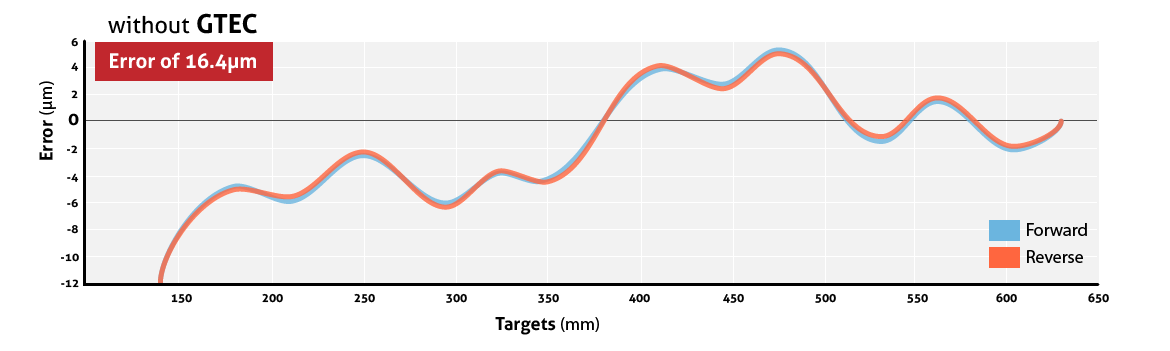
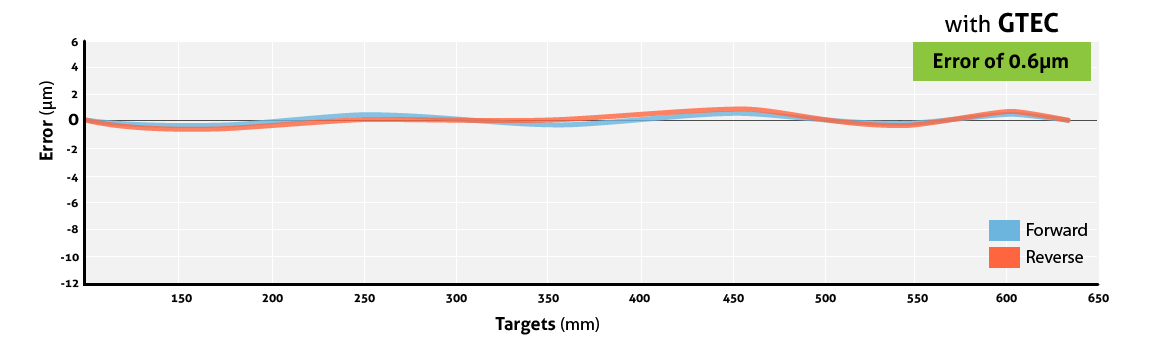
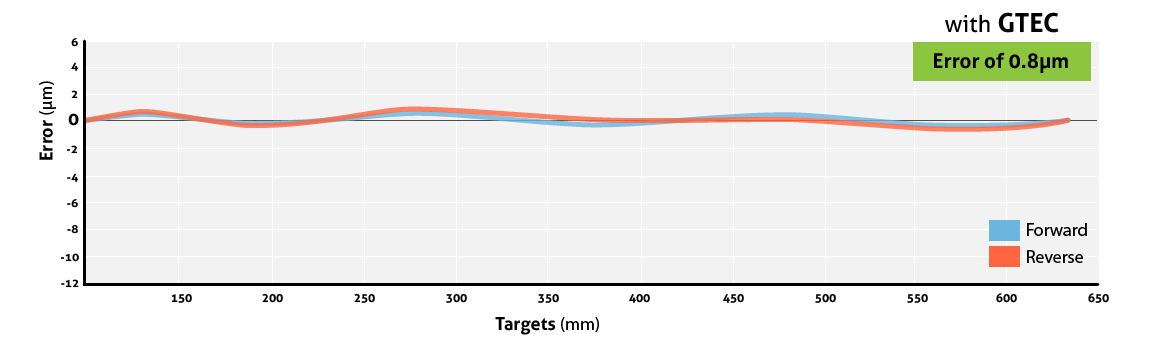
GEOMETRIC (VOLUMETRIC) – TYPICAL LINEAR COMPENSATION (Z-Axis)

Uncompensated the error is 16.4μm and exhibits a profile influenced by the guideway pinning. With compensation the error is reduced to 0.6μm.
The results displayed below show the maximum level of compensation we have achieved so far.



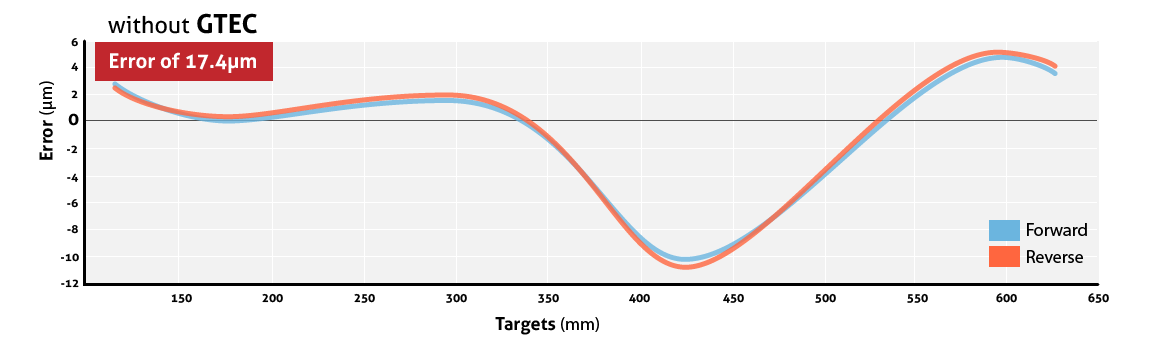
GEOMETRIC (VOLUMETRIC) TYPICAL STRAIGHTNESS (Z IN X)

The straightness error has a total range of 17.4μm before compensation & an impressive 0.8μm after.
Compensation is more difficult than for linear because it requires a stationary axis to overcome inertia.
This performance can only be achieved if the compensating axis has sufficiently good electrical and mechanical control.
The results displayed below show the maximum level of compensation we have achieved so far.


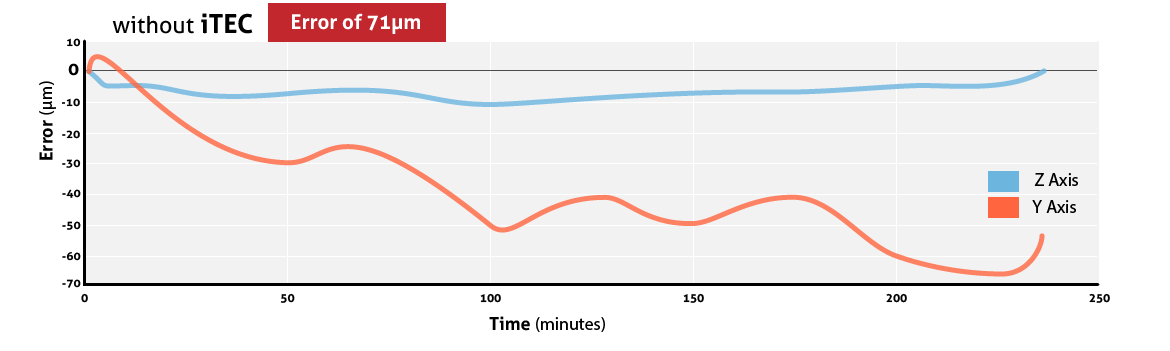
SPINDLE HEATING THERMAL COMPENSATION TEST

Random duty cycle spindle heating test
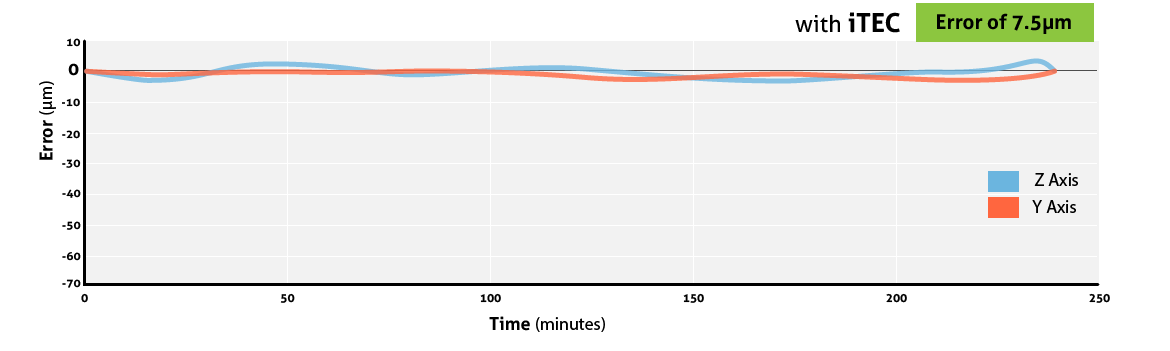
Position independent thermal errors in Y-axis direction reduced from 71μm to 7.5μm (≈90%)
Z Axis error reduced from 14μm to 3.5μm (≈75%)
The results displayed below show the maximum level of compensation we have achieved so far.


ENVIRONMENTAL COMPENSATION

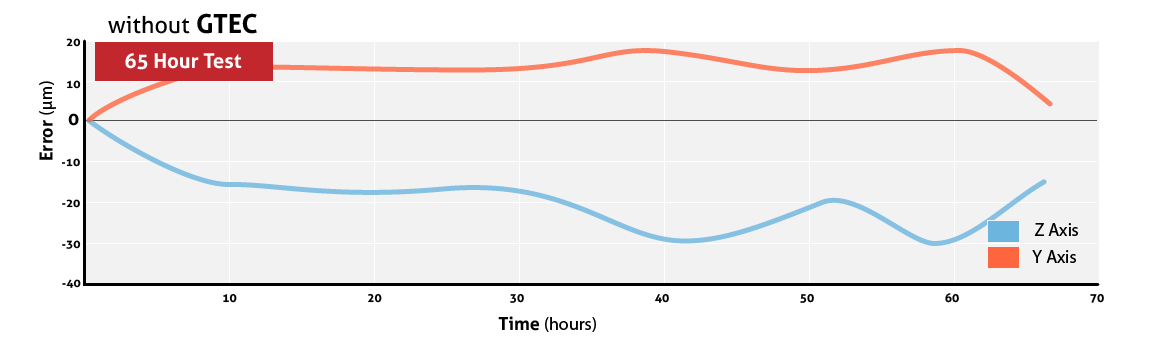
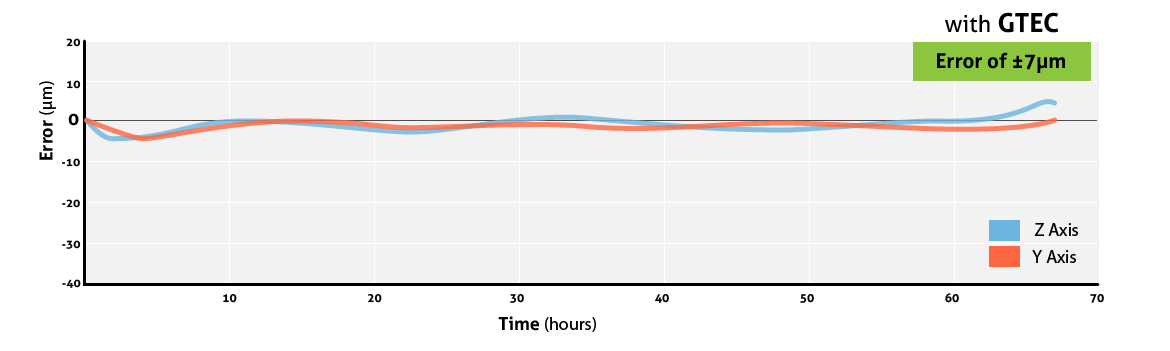
Extended environmental test resulting in substantial compensation of ±7μm over a 65 hour test
Residual error mainly where rapid changes in air temperature occur
The results displayed below show the maximum level of compensation we have achieved so far.


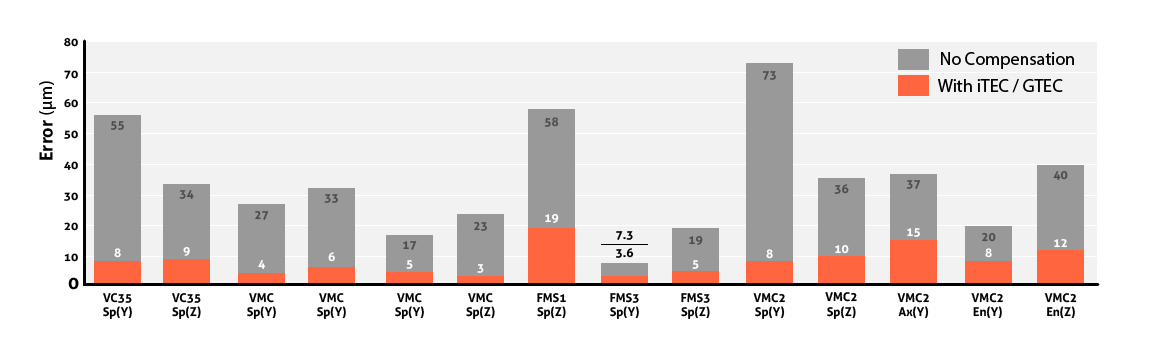
TYPICAL THERMAL COMPENSATION IMPROVEMENTS WITH iTEC & GTEC

Average = 73% reduction for ISO type measurements on a variety of machines
The results displayed below show the maximum level of compensation we have achieved so far.
Units in Microns
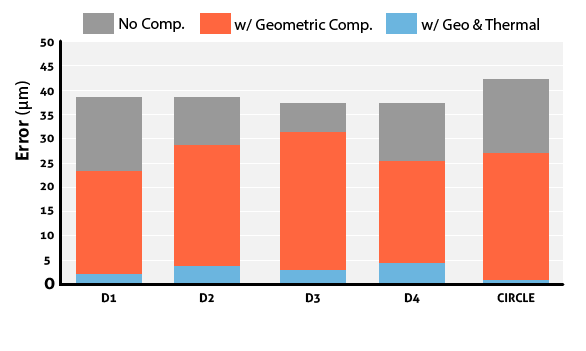
NAS CUTTING TEST RESULTS WITH GTEC


All 3 pieces were machined in similar environmental conditions 25ºC. The thermal effect is quite clear and the compensation was very successful.
Average feature improvement on test dominated by high workshop temperature:
With Geometric (volumetric) Compensation = 40%
With Geometric (volumetric) and Thermal Compensation = 92%